If you're a gift wholesaler, brand manager, or corporate procurement professional, here's why titanium drinkware deserves a serious look — and why now is the right time to get ahead of the trend.
What Makes Pure Titanium Different?
Most drinkware on the market today is made from 18/8 stainless steel (304 grade). It's durable and affordable — but it has real limitations that premium buyers are starting to notice.
Pure titanium (Ti>99.8%) is a fundamentally different material:
- No metallic taste. Stainless steel can subtly affect the flavor of beverages, especially tea and coffee. Titanium is completely inert — it has zero reaction with liquids, preserving the true taste of whatever your customers drink.
- 40% lighter than steel. A titanium thermos feels noticeably lighter in hand. For everyday carry products, this matters — customers notice, and they remember.
- Naturally antibacterial. Titanium has inherent antimicrobial properties, meaning bacteria are less likely to colonize the surface. No coatings, no additives — it's built into the material itself.
- Virtually indestructible. Titanium has one of the highest strength-to-weight ratios of any material on earth. A quality titanium cup, properly maintained, will last decades.
- Hypoallergenic. Unlike nickel-containing steel alloys, titanium is safe for people with metal sensitivities — an increasingly important consideration for consumer products.
Why Corporate Gifting Buyers Are Taking Notice
The shift toward titanium in premium gifting is being driven by three converging trends:
1. The "Premiumization" of Branded Merchandise
Corporate buyers are moving away from high-volume, low-cost giveaways. The ROI data is clear: a recipient who uses a premium gift daily creates more brand impressions per dollar than ten cheap items that end up in a drawer.
Titanium drinkware occupies a sweet spot — it's visibly premium (the weight, the finish, the feel all signal quality), functionally superior, and has a story worth telling. Your sales team can explain why it's better, not just that it's better.
2. Health and Safety Consciousness
Post-pandemic consumers are paying closer attention to what touches their food and beverages. Questions like "Is there BPA in this?" and "Does this leach chemicals?" have become mainstream.
Titanium answers all of these concerns definitively. It's FDA and LFGB compliant, used in medical implants and surgical tools, and has a decades-long safety track record. For brands that want to communicate care for their customers' wellbeing, titanium is a powerful signal.
3. Sustainability Positioning
Premium brands increasingly need to demonstrate environmental credentials. A titanium cup that lasts 20+ years is a more defensible sustainability story than a stainless steel product replaced every 2-3 years — even if the upfront cost is higher.
For corporate ESG reporting, gifting partners who offer genuinely long-lasting products are increasingly preferred.
The OEM Opportunity: Building Your Brand on Titanium
One of the most compelling opportunities for wholesale partners is private label titanium drinkware. Unlike commodity stainless steel products where margins are razor-thin and differentiation is nearly impossible, titanium gives you:
- A defensible price point. When customers understand the material, $80-120 retail for a titanium thermos is reasonable — compared to $25-40 for comparable steel products. Margins improve dramatically.
- A genuine product story. "Pure titanium, aerospace-grade, no taste transfer, lasts a lifetime" is a story your marketing team can work with. It's not just another thermos.
- Lower competition. The pure titanium drinkware category is still emerging in Western markets. Brands that establish themselves now will benefit from early mover advantage as consumer awareness grows.
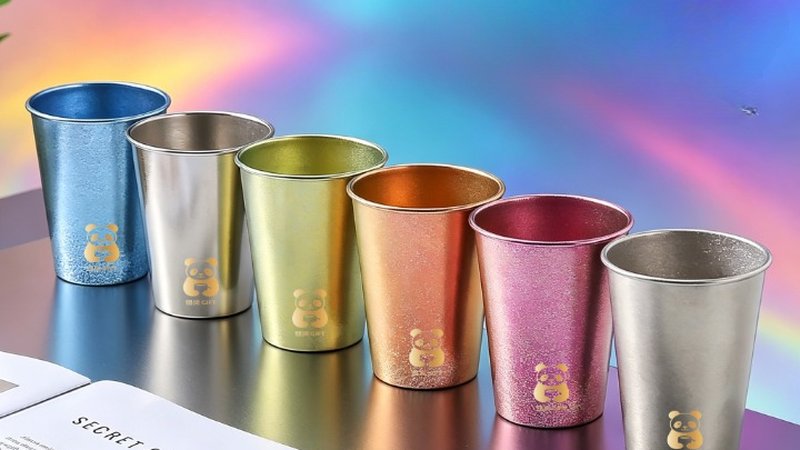
- Customization depth. Color anodization, laser engraving, custom packaging, and private labeling are all achievable at reasonable MOQs (typically 200+ pieces for full custom runs).
What to Look for in a Titanium Drinkware Supplier
Not all titanium drinkware is created equal. When evaluating suppliers, ask these questions:
- What is the titanium purity? Look for Ti>99.8% — this is aerospace-grade pure titanium, not a titanium alloy or titanium-coated steel. The difference matters for taste, weight, and durability.
- What certifications do they hold? For US market sales, FDA compliance is essential. For European markets, LFGB certification is the standard. Ask for test reports from accredited laboratories (CNAS or CMA accreditation in China is equivalent to ISO 17025).
- Where is manufacturing based? Yongkang, Zhejiang Province is China's drinkware manufacturing capital — the same industrial base that produces for Stanley, Snow Peak, and other recognized global brands.
- What is the minimum order quantity? Reputable manufacturers typically offer MOQs starting at 30 pieces for standard products, with custom OEM runs from 200 pieces.
- Can they provide samples before bulk orders? Any serious manufacturer should offer sample production (typically 5-7 days) before committing to full production.
Market Outlook: Where Is Titanium Drinkware Heading?
The Japanese market has been the early adopter — titanium drinkware has been a premium category in Japan for over a decade, with strong consumer education around material quality and health benefits.
European markets, particularly Germany and Scandinavia, are showing growing interest driven by health consciousness and sustainability positioning. The LFGB certification framework in Europe also provides a clear compliance pathway for imports.
The US market is earlier stage but moving quickly. Outdoor and adventure retail channels are the most receptive entry point, followed by corporate gifting and premium retail. As consumer education around titanium's benefits grows, mass-market adoption will follow.
For wholesale buyers and brand managers, the window to establish a titanium product line before the category becomes crowded is open — but it won't stay open indefinitely.
Getting Started
If you're considering adding titanium drinkware to your product range or exploring private label options, the practical next steps are straightforward:
- Request samples from 2-3 suppliers to compare quality firsthand. Focus on weight, finish consistency, lid mechanism quality, and how the cup performs in a taste test with plain water.
- Clarify your certification requirements before ordering. FDA and LFGB test reports should be available on request — if a supplier can't provide them, move on.
- Start with a proven form factor. Double-wall vacuum-insulated thermoses in the 300-500ml range are the most established category. Build customer confidence with a proven product before expanding into more specialized items.
- Plan your product story. The material advantage only converts to sales if your team can communicate it. Invest in simple, clear messaging around purity, taste, weight, and durability.
GIFT Titanium manufactures pure titanium drinkware in Yongkang, Zhejiang, with FDA and LFGB compliant products tested by CNAS-accredited laboratories. We work with global brands, gift wholesalers, and corporate procurement teams. MOQ starts at 30 pieces.